HITO 人
The Physics and Metaphysics of Being Held
Eros, Sentience, Relationality, and the Biology of Aliveness
Movement I: The Tenderness of Being Held
I once saw a video of a bird at a café table, somewhere in Europe. It was one of those small, elegant tables with a little coffee cup, perhaps a saucer, perhaps the remains of something sweet that had been served beside the coffee, one of those thin biscuits or crackers that leave delicate crumbs behind. The human beings had already moved on, as we so often do, leaving behind the smallest evidence of our abundance: crumbs, sugar, a ring of coffee, a napkin touched and forgotten. And there, in the quiet afterlife of the table, a bird arrived.
It began picking up the crumbs. Not one crumb, not a single dramatic gesture, but again and again, with that quick, trembling intelligence of birds, light and precise and almost unbearably alive. It would take a crumb into its beak, hop across the large table to the other side, and bring it to another bird who was sitting there. Then it would return. It would pick up another crumb and carry it back again. And then again. And again. The repetition is what moved me. It was not an accident, not a momentary overflow, not one symbolic offering that allowed the giver to return immediately to itself. It was a pattern of care. A small choreography of nourishment crossing distance.
I do not know whether the bird was male or female. I do not know whether the other bird was a mate, a child, an elder, a weaker one, injured perhaps, afraid perhaps, simply waiting perhaps. I do not know why the second bird did not come for the crumbs itself. Perhaps it could not. Perhaps it was young. Perhaps it was fragile. Perhaps the relationship between them had a logic I could not see from the outside. But the reason did not matter as much as the movement. Something in one being perceived that another being was not coming to the food, and instead of keeping the nourishment for itself, it carried the nourishment across.
I was astonished by the mercy of it. That is the word that comes to me. Mercy. Not mercy as pity, not mercy as superiority, not the sentimental mercy of one above another, but mercy as the tenderness of life recognizing life. The gesture was so small, and yet it opened something immense. It showed me, in the simplest possible form, what I have been looking for my whole life, what I have longed to receive, what I have tried to give, and what I notice everywhere because my own body has been shaped by the absence and presence of it: the movement toward the fragile one.
This is how I pay attention in nature. I look for the places where life reveals its secret law. Not in spectacle, not only in beauty, not only in the grand intelligence of mountains, oceans, storms, birth, death, or the migration of species, but in the little acts that would disappear if no one were tender enough to see them. A bird carrying crumbs. A dog resting its head on the lap of someone grieving. A horse sensing fear before the person has spoken. A mother animal placing her body between danger and the small. A tree feeding another through the hidden intelligence of the forest. These are not sentimental images to me. They are metaphysical evidence. They show that care is older than philosophy. They show that upholding belongs to the grammar of life itself.
Perhaps we notice what our souls are asking life to explain to us. Perhaps attention is never neutral. Perhaps I saw the bird because something in me has always been listening for this gesture: will the one who has food notice the one who does not come to the table? Will the one who is stronger in this moment move toward the one who is weaker? Will abundance stay enclosed in the self, or will it travel? Will life remain private, or will it become merciful?
This is where I would begin a book on health, longevity, Eros, regeneration, vitality, and the future of humanity. Not with the newest molecule. Not with optimization. Not with the lonely heroism of the self-made body. Not with the fantasy that a human being becomes well by mastering itself as an isolated system. I would begin with the bird, with the crumbs, with the table, with the repeated crossing. Because before medicine becomes technology, before longevity becomes protocol, before ethics becomes theory, before love becomes language, life is already asking the most important question: when another being is less in its power, does something in us move toward it?
There are moments in every life when one being is less in its power than another. This is not a permanent hierarchy. It is the weather of existence. One day I have food and you are hungry. One day I have strength and you are tired. One day I have money and you are afraid. One day I have clarity and you are overwhelmed. One day I can stand and you need to lean. One day you will carry the crumb to me. One day I will carry it to you. The delusion is not dependence. The delusion is to imagine that our moments of power belong only to us.
To be held is one of the first medicines of life. Before we understand ourselves as separate, before we acquire agency, ambition, beauty, talent, identity, philosophy, or the later refinements of personhood, we are held. We are carried inside another body. We are fed before we can name hunger. We are warmed before we can understand cold. We are regulated by voice, skin, scent, rhythm, milk, gaze, breath. The infant does not encounter existence first as independence. The infant encounters existence as response. Life comes as arms, breast, sound, temperature, timing, return. To be alive, in the beginning, is to be received.
This is not only developmental psychology. It is metaphysics made flesh. The body begins as an open question answered by another. Am I safe? Will warmth come? Will food come? Will the face return? Will the world meet me before the fear becomes too large for my small body to bear? The earliest medicine is not conceptual. It is not even emotional in the adult sense. It is the repeated experience that the field responds. That the cry enters someone. That hunger matters. That fragility reorganizes another body into care.
And perhaps this is why abandonment wounds so deeply later. Not because we are weak. Not because we should have no needs. Not because the mature human being ought to be immune to the absence of care. But because somewhere in the old intelligence of the body, love and safety were never separate from response. The body knows the difference between being admired and being held. It knows the difference between being told one is strong and being supported where strength is costing too much. It knows the difference between beautiful words and the arrival of help. It knows the difference between someone who sees our fragility as an inconvenience and someone whose tenderness moves toward it.
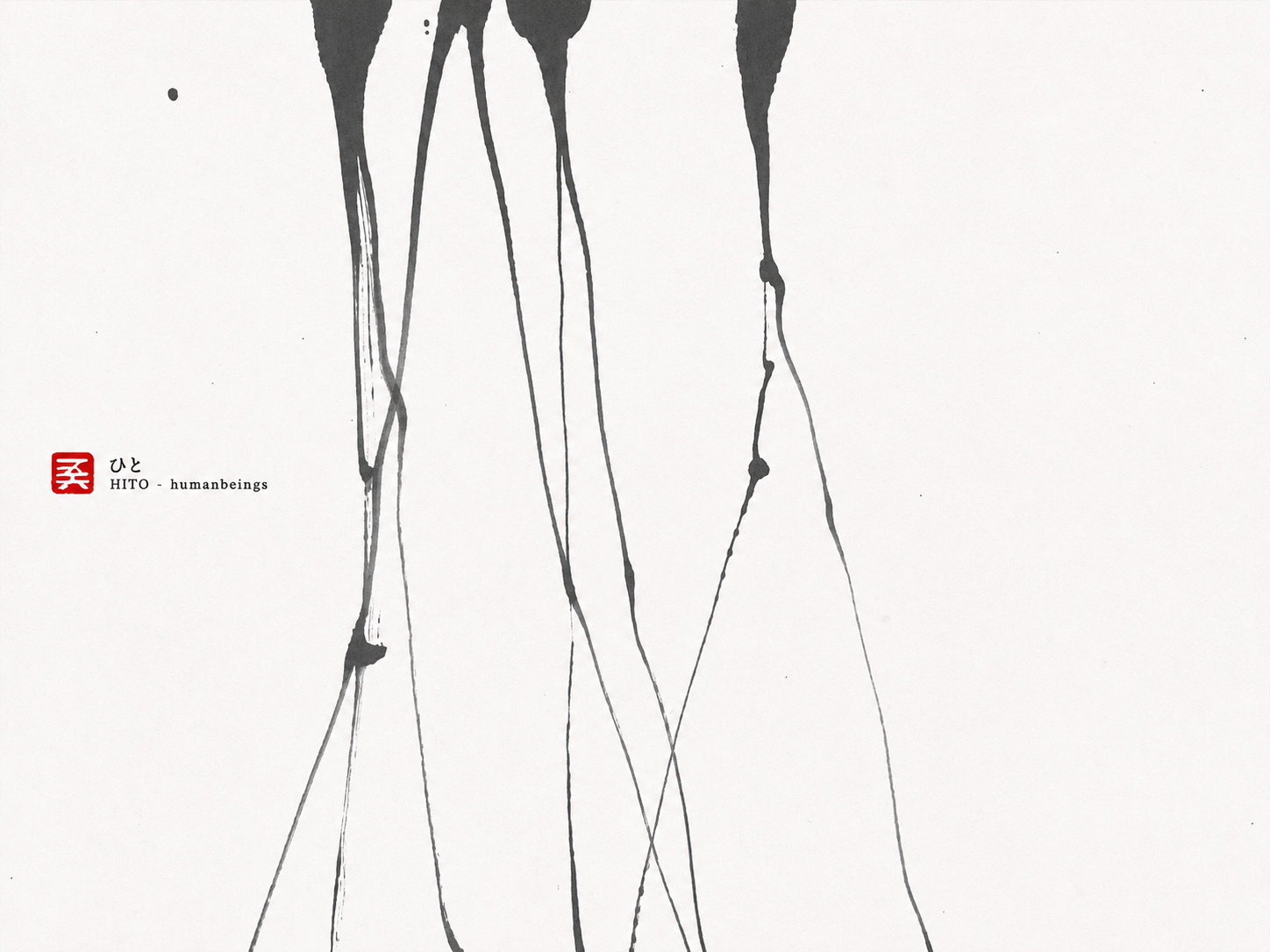
The Japanese kanji for person, 人, has lived inside me for many years as one of the simplest and most elegant symbols of this truth. At first glance, it looks almost like a human figure in motion, someone running freely into the world. This is how the modern eye wants to see itself: singular, directed, independent, unburdened. But do not be fooled. The character is made of two strokes. One leans into the other. One upholds the other. The person is not written as an isolated vertical line, but as a small architecture of relation. The human appears through contact.
人
I wrote about this long ago, while I was still living inside my Japanese marriage, before I had the full language for what this symbol would come to mean in my work as a physician, artist, mother, and woman trying to understand what makes life flourish or collapse. I wrote then that the kanji for person looks like a human running free, but that we should not be fooled. It is two strokes, one upholding the other. I wrote it as a gentle reminder for us to uphold each other, to have each other’s back, to stand in full agency and still co-create life with others, because we never stand alone anyhow. Even then, the sentence had the strange weight of recognition. You never stand alone anyhow. Not as consolation. As fact.
Even the word independence begins to soften when one listens to it carefully. In-dependence still carries dependence inside it. It is not the absence of dependence, but the refinement of dependence into maturity, reciprocity, dignity, and conscious relation. No human being has done one thing alone in the absolute sense. We did not birth ourselves. We did not invent the language with which we say “I.” We did not grow all our food, build every road, create every medicine, carry every bucket of water, generate every current of light, or teach our own infant nervous systems how to return from fear. We are world-made before we are self-made. We are held by bodies, mothers, fathers, animals, plants, soil, microbes, strangers, ancestors, weather, language, culture, friendship, labor, and the immeasurable mercy of all that arrives before we know how to thank it.
This is why the phrase “do what is best for you” can feel so foreign to a person whose being is organized around relation. It sounds simple, generous even, and sometimes it is meant that way. But for many of us, especially for those who mother, hold, build, feed, remember, and carry others in the fabric of our decisions, there is no isolated “best for me” floating apart from the field. My life is not arranged as a private preference machine. My choices carry children, parents, beloveds, animals, patients, homes, histories, debts, promises, vulnerabilities, and future consequences. To ask only what is best for me can feel like being asked to amputate the field in order to answer.
This is one of the places where the agency-first mind misunderstands the relational body. Agency-first love says, choose yourself, do what you want, take care of your needs, stand in your sovereignty. There is truth in this, and sometimes it is lifesaving. But when agency is severed from upholding, it becomes thin. It begins to sound like freedom spoken by someone who does not have to account for the beings attached to their choices. For the one who lives as field, the question is never only what do I want? The question is what allows life to hold? What keeps the children safe, the body coherent, the work alive, the animal fed, the future possible, the beloved not abandoned, the self not erased? This is not lack of agency. It is agency in relation.
Being held, then, is not the opposite of freedom. It may be one of the conditions through which freedom becomes livable. The child held well explores more, not less. The patient believed can heal more, not less. The woman whose real conditions are supported becomes more radiant, not less sovereign. The man met without contempt can become more tender and courageous, not smaller. The animal who trusts the hand does not become less alive. It becomes less afraid. True holding does not take the self away from itself. It returns the self to itself.
This is the tenderness of being held. It is not rescue. It is not possession. It is not the collapse of one life into another. It is the felt presence of a field that responds. It is the quiet dignity of not being abandoned at the exact point where life has become too heavy. It is the difference between being admired from a distance and being met in the body of reality. It is the difference between beautiful language and embodied care. It is the difference between survival as endurance and life as something that can still open.
For me, this has always been the deepest question. Not because I want to be spared life, and not because I do not know how to stand. I know how to stand. Many women know how to stand so well that the world mistakes our standing for proof that nothing more is needed. But the soul still knows the difference between standing because the field is strong beneath us and standing because falling is not an option. The body knows the difference between power born of surplus and power born of necessity. It knows the difference between being left to carry and being met in the carrying.
Perhaps this is why the bird at the café stays with me. It kept returning. It kept carrying. It kept crossing the distance between nourishment and the one who waited. In that repetition there was a mercy so simple that it almost broke the heart. A being found food and allowed the existence of another to change the path of its own hunger. That is where the metaphysics begins for me. Life recognizing life. Life moving toward life. Life held, and holding.
The human being, written correctly, is not alone.
Movement II: The Object That Knew Before I Did
Long before I could have written this book, I had already begun making it with my hands. This is often how the body tells the truth before the mind has permission to know it. We shape an object, a room, a meal, a necklace, a ritual, a garden, a sentence, and only years later do we understand that the thing we made was holding a question we were not yet able to ask directly. Art sometimes arrives before consciousness. It gives matter to the unspeakable. It lets the invisible press against the skin.
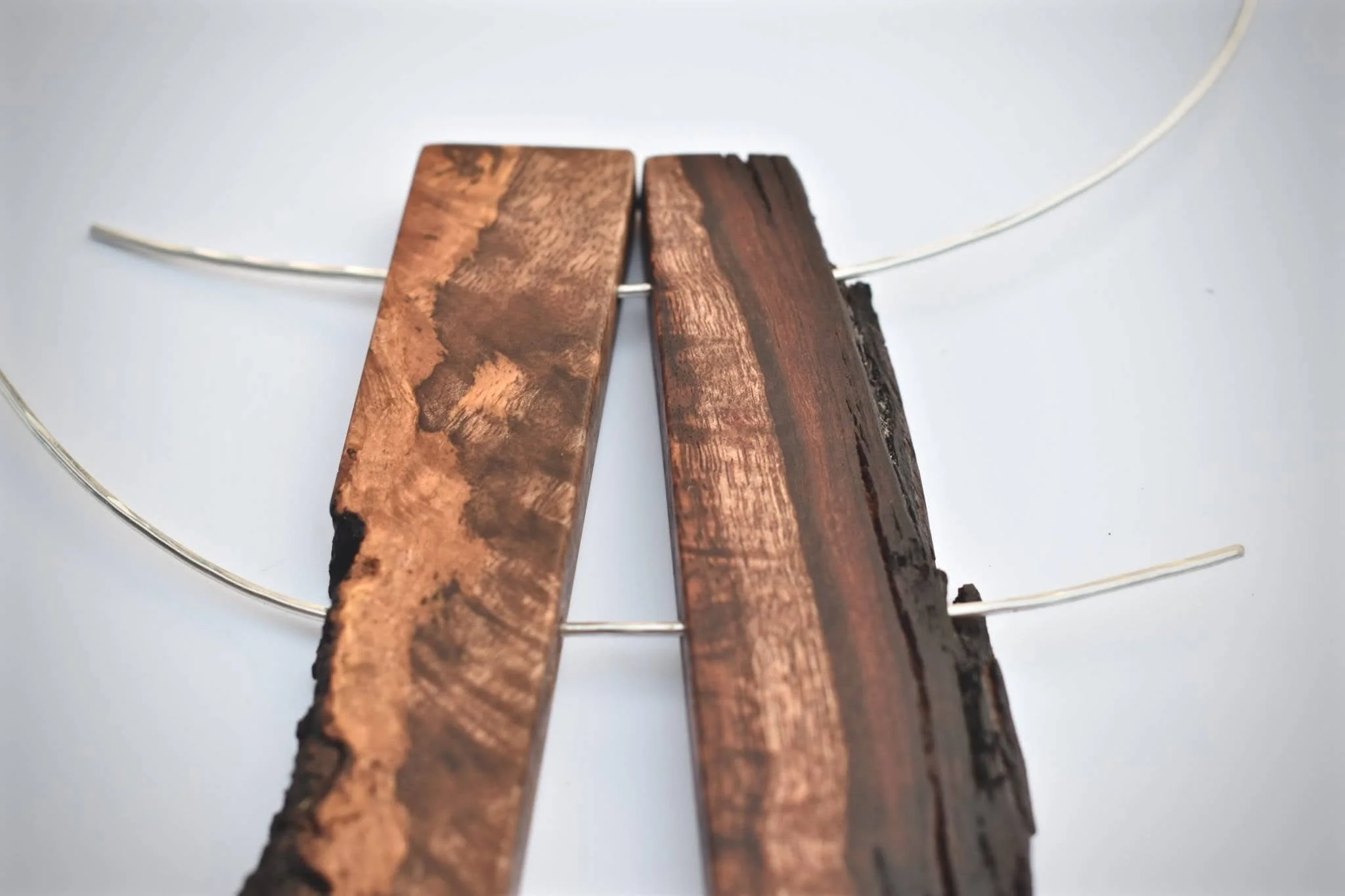
During my Japanese marriage, through blissDesigned, I created a sculpture-wear series that became part of the Love Series exhibited in Hawaii. The pieces were made of koa wood and metal, worn around the neck on a strong circular wire. Two pieces of wood met at the center of the body. They touched. They did not collapse into one. They did not remain apart as separate ornaments. Their meaning lived precisely in the place where they came into contact.
Koa is not an innocent material. It carries the body of the islands, the density of tree, sun, rain, age, wind, salt, human hand. Wood always remembers that it was once alive. To place it near the throat and heart, held by a metal circle around the neck, was to make a kind of primitive philosophy out of elemental things: tree, skin, breath, curve, pressure, contact. The piece was not decoration to me. It was a question placed on the body. It asked what relation might be when two distinct forms are held close enough to matter, but not so close that one consumes the other.
I see now that I was trying to understand love through matter. Not love as fantasy, not love as private feeling, not love as chemistry alone, but love as architecture. Love as the invisible geometry between beings. Love as the living tension between selfhood and contact. Love as the exact distance at which two lives can remain themselves and still become responsible to the field between them. The sculpture asked something that many relationships never learn how to ask: how do we touch without taking over, how do we lean without collapsing, how do we stay free without abandoning the other to the loneliness of their own weight?
At the time, I was living inside a marriage that was not simple. There was loyalty there, and fatherhood, and tenderness in certain places, and the long familiarity of shared years, children, homes, meals, fatigue, beauty, immigration, striving, disappointment, daily life. It was not a story that could be flattened into cruelty. That would be too easy and not true enough. But there was also a deep ache in me, the ache of carrying too much of the structure. I loved a man who, in some part of himself, wanted to care, but did not know how to stand in the practical force of care. He was sensitive, artistic, present in ways that mattered, but frightened, I think, of money, worldly force, external responsibility, the architecture of provision, the sober ground-work by which life becomes stable enough for others to breathe.
And so I carried. I provided. I organized. I translated. I held the anxiety of the future in my body. I made life continue. This is one of the quiet tragedies of many women’s lives: we become extraordinarily capable precisely where we were not held. The muscle develops at the site of the missing support. Then others admire the muscle and fail to see the deprivation that formed it. They call us strong, powerful, impressive, resilient, but the body remembers the cost. It remembers that strength was not always freedom. Sometimes strength was the only way life could remain standing.
The sculpture-wear came from that place, although I did not know it fully then. I was not making complaint. I was making beauty. I was making form. I was making something tender and strong enough to hold a question without humiliating anyone inside the answer. Two pieces of koa wood, separate and touching. A circle around the neck. A point of meeting at the center of the body. The object knew something my life was still trying to learn: that love cannot be only presence, and it cannot be only loyalty, and it cannot be only the wish to care. Love must also become a structure in which the weight of life is not carried silently by one body while the other remains aesthetically near.
There is a difference between closeness and upholding. This difference has taken me many years to understand with enough tenderness. Many people are close and still not held. Many people share a home, a bed, a child, a business, a history, a spiritual language, a sensual life, even a deep affection, and still the field between them may not be organized in a way that allows both to flourish. One may remain the atmosphere, the memory, the organizer, the emotional translator, the economic stabilizer, the keeper of continuity, while the other participates in the beauty of the life without fully entering the weight that makes the beauty possible. This is not always malicious. Sometimes it is unconscious. Sometimes it is fear. Sometimes it is underdevelopment. Sometimes it is a person loving sincerely but without the architecture of upholding.
That distinction matters because the absence of upholding is not always visible from outside. A marriage may appear loyal. A family may appear intact. A man may be present, kind, beloved by the children, gentle in certain moods, and still the woman may feel alone in the deepest structure of life. She may not be abandoned in the dramatic sense, and yet she may be unheld in the biological sense. Her body may know that the field depends too much on her. Her nervous system may carry the quiet knowledge that if she falls, too much falls with her. This knowledge changes the metabolism of love. It makes tenderness harder to receive. It makes rest feel dangerous. It makes erotic softness more difficult because the body cannot fully soften when it is also the structure.
I think this is why the sculpture-wear still moves me. It did not say, one must disappear so the other can stand. It did not say, one must dominate and the other be held in helplessness. It did not say, love is fusion. It did not say, freedom means separation. It held the more difficult truth: two distinct forms, held in relation, creating beauty through contact. Not ownership. Not rescue. Not collapse. Not abandonment disguised as autonomy. A shared architecture.
The circle mattered too. I feel that now. The two wooden forms touched, but the circle carried them. Relation does not happen in emptiness. Love needs a field. A family needs structure. A body needs rhythm. A nervous system needs enough predictability to trust. A woman’s eros needs ground. A child’s development needs continuity. A friendship needs return. A civilization needs systems through which care can circulate. The circle around the neck was not only metal. It was the field itself. It was the invisible holding without which the two pieces could not meet in the way they did.
Perhaps every true relationship requires such a circle. Not a cage, not a contract of domination, not the suffocation of form without breath, but an agreed-upon field where contact can become meaningful and safe. Without some circle of responsibility, two beings may touch and still not be held. They may love and still remain structurally alone. They may desire and still not create a life in which desire can deepen. They may speak of freedom while the field quietly deteriorates from the absence of enough care.
The body knows this. The body is never fooled for very long by the aesthetics of relation. It can feel when contact is held by structure and when contact is floating. It can feel when love has entered the ordinary material of life and when it remains in the beautiful air above it. It can feel when someone’s presence changes the weight and when their presence only changes the mood. It can feel the difference between being admired and being supported, between being close to someone and having one’s life made more coherent by their nearness.
This is why the piece was not merely an object I designed. It was a witness. It witnessed a longing in me that was older than the marriage and larger than any one man. It witnessed my longing for mutuality, for a form of love in which agency and care do not oppose each other, in which one can be free and still answer the field, in which two beings do not confuse non-dependence with maturity. It witnessed my longing for the human being written correctly: not one heroic line standing alone, but one stroke leaning into another in the sacred geometry of support.
There is tenderness in realizing that the art knew before I did. There is also grief. Because sometimes we make in beauty what we are not yet able to receive in life. Sometimes the soul creates its own medicine in symbolic form because the daily field has not yet learned how to offer it. The sculpture-wear did not solve the ache, but it honored it. It gave it dignity. It said: this longing is not weakness. This longing has form. This longing belongs to a deep law of being.
When I look at those pieces now, I see not only a chapter of my artistic life, or a memory of Hawaii, or the woman I was then trying to build beauty from the materials available to her. I see the beginning of this book. I see HITO made wearable. I see the metaphysics of upholding resting against the sternum. I see two forms asking how love can become contact without becoming consumption, and support without becoming possession. I see the quiet truth that being held is not the opposite of being oneself. It may be the condition through which the self finally has enough ground to become fully alive.
The object knew.
The wood knew.
The body knew.
The point of contact knew.
And perhaps this is what art does at its most merciful. It lets the future speak through matter before the present has learned how to listen.